


Monahdhon
“A Strategic Study on the Impact of the Continued Iranian Occupation of Al-Ahwaz on Arab Regional Security and International Stability”
The Ruwad Al-Nahda Movement for the Liberation of Al-Ahwaz (RNMLA)
Media Office
Strategic Studies Department
AHWAZ AND ARAB NATIONAL SECURITY
A Strategic Study on the Impact of the Continued Iranian Occupation of Al-Ahwaz on Arab Regional Security and International Stability
Prepared by
Strategic Studies Department
Media Office
The Ruwad Al-Nahda Movement for the Liberation of Al-Ahwaz (RNMLA)
Supervised and Reviewed by
Media Office
The Ruwad Al-Nahda Movement for the Liberation of Al-Ahwaz (RNMLA)
Date of Publication
06 June 2026
Dedication
To the steadfast Arab people of Al-Ahwaz who continue to endure and resist on their occupied homeland.
To all those who believe in the universal right of peoples to freedom, self-determination, and national dignity.
To the defenders of Arab national security and the Arab nation’s right to stability, development, sovereignty, and prosperity.
This study is dedicated as a contribution to understanding one of the most significant strategic issues influencing both the present and future of our region.
Foreword
The issue of Al-Ahwaz represents one of the most significant Arab causes in the contemporary Middle East, carrying profound historical, political, economic, and strategic dimensions. Its implications extend far beyond the Arab people of Al-Ahwaz themselves, directly affecting Arab national security, regional stability, global energy markets, maritime trade routes, and international geopolitical balances.
Since the occupation of Al-Ahwaz in 1925, successive Iranian governments have systematically exploited the region’s vast resources to advance their political, military, and strategic ambitions. Simultaneously, the Arab people of Al-Ahwaz have been subjected to policies aimed at undermining their national identity, historical presence, cultural heritage, and legitimate political rights.
This study forms part of the research efforts undertaken by the Strategic Studies Department of The Ruwad Al-Nahda Movement for the Liberation of Al-Ahwaz (RNMLA). It seeks to provide a comprehensive historical, geopolitical, economic, and security assessment of the Ahwazi cause and its direct relationship to the future of Arab national security.
The study proceeds from the principle that supporting the Arab people of Al-Ahwaz in exercising their right to self-determination is not only a legal and moral obligation toward a people living under occupation but also a strategic necessity for addressing one of the principal sources of instability and tension in the Arabian Gulf and the broader Middle East.
Executive Summary
Al-Ahwaz constitutes one of the most strategically important geopolitical regions in the Middle East due to its unique geographical position, abundant natural resources, and central role within Iran’s economy.
Since its occupation in 1925, Al-Ahwaz has become a major source of Iranian economic and military power, enabling successive Iranian governments to expand their military capabilities, project influence across the region, and intervene in numerous Arab affairs.
This study is based on the premise that continued Iranian control over Al-Ahwaz remains one of the principal factors contributing to the strategic imbalance in the Arabian Gulf and the Middle East. It further argues that enabling the Arab people of Al-Ahwaz to exercise their legitimate right to self-determination would significantly strengthen Arab national security and reduce sources of regional instability.
Research Methodology
This study employs:
- Historical analysis of the development of the Ahwazi issue since 1925.
- Descriptive and analytical approaches to assess contemporary political, economic, and military realities.
- Geopolitical systems analysis to evaluate the influence of Al-Ahwaz on regional and international security.
- Review of legal and political literature concerning the right of peoples to self-determination.
- Analysis of energy and economic data published by international institutions and specialized research organizations.
Objectives of the Study
The study aims to:
- Highlight the strategic significance of Al-Ahwaz within Arab national security frameworks.
- Analyze the implications of continued Iranian occupation for regional stability.
- Explain the role of Ahwazi resources in sustaining Iranian power.
- Assess the security and economic impacts on Gulf states, Iraq, Jordan, and Egypt.
- Explore future scenarios related to the Ahwazi issue.
- Present a strategic Arab liberation-oriented vision regarding the future of Al-Ahwaz and the region.
Scope of the Study
This study covers the period from 1925 to 2026 and focuses on the following dimensions:
- Historical
- Geopolitical
- Economic
- Military
- Security
- Legal
The study also examines the relationship between the Ahwazi cause and Arab national security within a broader regional and international context.
This study is issued by the Strategic Studies Department of the Media Office of The Ruwad Al-Nahda Movement for the Liberation of Al-Ahwaz (RNMLA) and reflects a research perspective grounded in the Arab people of Al-Ahwaz’s right to freedom and self-determination in accordance with international law and the Charter of the United Nations.
Chapter One
Al-Ahwaz: Geography, History, and National Identity
Geographical Location
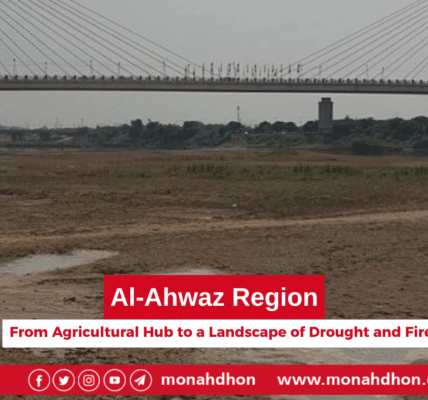
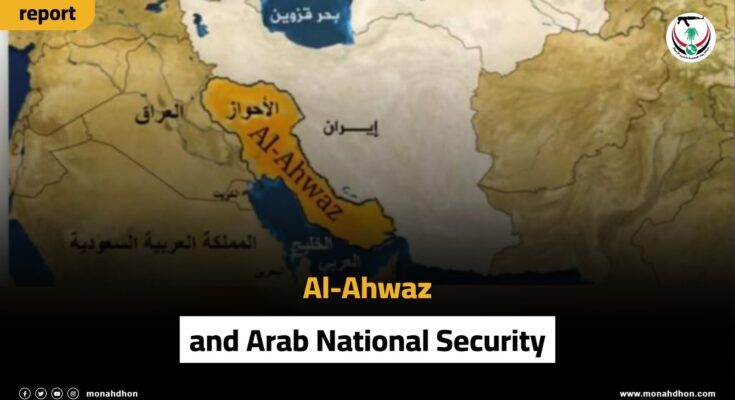
Al-Ahwaz is located on the eastern coast of the Arabian Gulf, extending from the Iraqi border in the west to the Zagros Mountain range in the east.
According to numerous historical and geographical studies, Al-Ahwaz covers an estimated area exceeding 375,000 square kilometers.
The region overlooks:
- The Arabian Gulf.
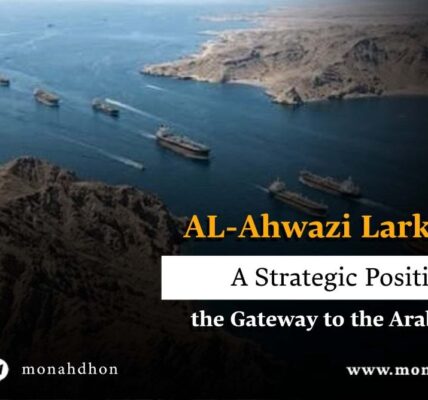
- Bab Al-Salam (Hormuz) Strait.
- Major international maritime energy routes.
Historical Background
For centuries, Al-Ahwaz was governed by Arab emirates, most notably the Emirate of Bani Kaab, whose capital was Mohammerah.
In 1925, the Pahlavi state under Reza Shah overthrew the Arab government of Al-Ahwaz and annexed the territory by military force, marking a major turning point in regional history.
Subsequently, successive Iranian governments implemented policies of:
- Persianization.
- Demographic engineering.
- Land confiscation.
- Restrictions on the Arabic language.
- Erosion of Ahwazi national identity.
Chapter Two
The Economic and Strategic Importance of Al-Ahwaz
Oil Resources
International estimates indicate that Al-Ahwaz contains the majority of Iran’s major oil fields.
Among the most important are:
- Al-Ahwaz Oil Field.
- Marun Oil Field.
- Sayyid Jari (Aghajari) Oil Field.
- Masjed Soleyman Oil Field.
- Maysan (Azadegan) Oil Field.
Energy studies suggest that between 70 and 80 percent of Iran’s oil production originates from Ahwazi territories.
Natural Gas Resources
Al-Ahwaz serves as a major center of Iranian natural gas production.
The region hosts some of Iran’s largest facilities for:
- Gas processing.
- Refining.
- Petrochemical industries.
Ports
Al-Ahwaz contains several strategically important ports on the Arabian Gulf, including:
- Khor Musa Port.
- Ma’shour Port.
- Abadan Port.
- Mohammerah Port.
These ports play a critical role in Iranian oil exports and international trade.
Water Resources
Al-Ahwaz includes major rivers such as:
- Karun River.
- Karkheh River.
- Jarahi River.
These waterways are vital sources of water, agriculture, and energy production.
Chapter Three
Al-Ahwaz as a Source of Iranian Strategic Power
Contemporary Iranian power is built upon three principal pillars:
- Economic resources.
- Military capabilities.
- Regional influence.
All three pillars are directly linked to Al-Ahwaz.
Revenue generated from Ahwazi oil and gas resources serves as a major source of funding for:
- The Islamic Revolutionary Guard Corps (IRGC).
- Military industries.
- Missile and drone development programs.
- Regional and external operations.
Chapter Four
Implications of the Continued Occupation of Al-Ahwaz for Gulf Security
Military Threats
Over recent decades, Al-Ahwaz has been transformed into a heavily militarized zone hosting:
- Naval bases.
- Missile installations.
- Air defense systems.
- Maritime surveillance centers.
This infrastructure provides Tehran with significant leverage over Gulf security dynamics.
Threats to International Navigation
A substantial proportion of global energy trade passes through the Arabian Gulf.
Any military escalation originating from Al-Ahwazi shores directly affects:
- Global oil markets.
- Energy prices.
- International commerce.
Political Leverage
Control of Al-Ahwaz enables Iran to maintain strategic pressure mechanisms against Arab Gulf states.
Chapter Five
The Impact of the Non-Liberation of Al-Ahwaz on Iraq
Iraq remains among the Arab states most affected by Iranian policies in political, security, and economic spheres.
The continuation of Iranian control over Al-Ahwaz contributes to sustaining Tehran’s regional influence and strategic depth, with direct consequences for Iraqi national sovereignty and regional stability.
Chapter Six
The Impact of Continued Iranian Control of Al-Ahwaz on Jordan
Although Jordan shares no direct border with Iran, it remains affected by the broader regional repercussions of Iranian policies, including security challenges, energy concerns, and instability affecting regional trade and development.
Chapter Seven
The Ahwazi Cause and Egyptian National Security
The strategic importance of Egypt within the Arab regional system makes developments in the Arabian Gulf directly relevant to Egyptian national interests, particularly concerning maritime security, regional stability, and international trade.
Chapter Eight
The International Dimension of the Ahwazi Cause
The Ahwazi issue extends beyond regional politics and has implications for global energy security, international shipping routes, economic stability, and broader geopolitical balances.
Chapter Nine
Future Scenarios
Scenario One: Continuation of the Status Quo
- Continued regional tensions.
- Rising military expenditures.
- Persistent security threats.
Scenario Two: Limited Internal Reforms
- Partial mitigation of tensions.
- No resolution of the root causes of the Ahwazi issue.
Scenario Three: Self-Determination for the Arab People of Al-Ahwaz
- Rebalancing regional geopolitics.
- Reducing sources of instability.
- Enhancing security and stability in the Arabian Gulf.
Chapter Ten
The Vision of The Ruwad Al-Nahda Movement for the Liberation of Al-Ahwaz (RNMLA)
RNMLA believes that:
- The Arab people of Al-Ahwaz possess an inherent right to self-determination under international law.
- The Iranian occupation of Al-Ahwaz constitutes a national liberation issue.
- Arab national security is directly linked to the future of Al-Ahwaz.
- Supporting the legitimate rights of the Ahwazi people is consistent with the principles of international justice and the rights of peoples.
- Establishing strategic Arab–Ahwazi partnerships represents a cornerstone for future stability in the Arabian Gulf.
Conclusion
Historical, economic, and strategic evidence demonstrates that Al-Ahwaz constitutes far more than a resource-rich territory. It represents a geopolitical center of gravity upon which a significant portion of Iranian regional power is built.
Consequently, continued Iranian control over Al-Ahwaz remains a major factor influencing Arab national security, global energy markets, and international trade stability.
The study concludes that addressing the root causes of regional instability requires a long-term strategic approach that recognizes the Arab people of Al-Ahwaz’s right to freedom and self-determination while promoting a more balanced regional order founded upon respect for the rights of peoples and the sovereignty of nations.
Appendices
Appendix I: Major Oil Fields in Al-Ahwaz
- Al-Ahwaz
- Marun
- Sayyid Jari (Aghajari)
- Maysan (Azadegan)
- Yaran
- Masjed Soleyman
Appendix II: Major Ports in Al-Ahwaz
- Mohammerah
- Abadan
- Ma’shour
- Khor Musa
Appendix III: Key Historical Milestones
1925: Overthrow of Arab rule in Al-Ahwaz and annexation by Iran.
1979: Establishment of the Islamic Republic of Iran.
1980–1988: Iran–Iraq War.
2005: The Ahwazi April Uprising.
2018–2025: Expansion of Ahwazi political and human rights advocacy on the international stage.
Selected References
- Charter of the United Nations.
- International Covenant on Civil and Political Rights.
- United Nations General Assembly Resolutions on the Right of Peoples to Self-Determination.
- International Energy Agency (IEA) Reports.
- U.S. Energy Information Administration (EIA) Reports.
- OPEC Statistical Reports and Publications.
- Middle East Institute Studies.
- Gulf Research Center Publications.
- International Human Rights Reports on the Situation of the Ahwazi People.
- Political Literature, Strategic Documents, and Policy Papers Issued by The Ruwad Al-Nahda Movement for the Liberation of Al-Ahwaz (RNMLA).